
Africana Studies Resources
Slavery and Antislavery Resources

"Jamaica Island, Trelawny Town parcels." Manuscript map, 1777 [Charles Vaughan Papers].
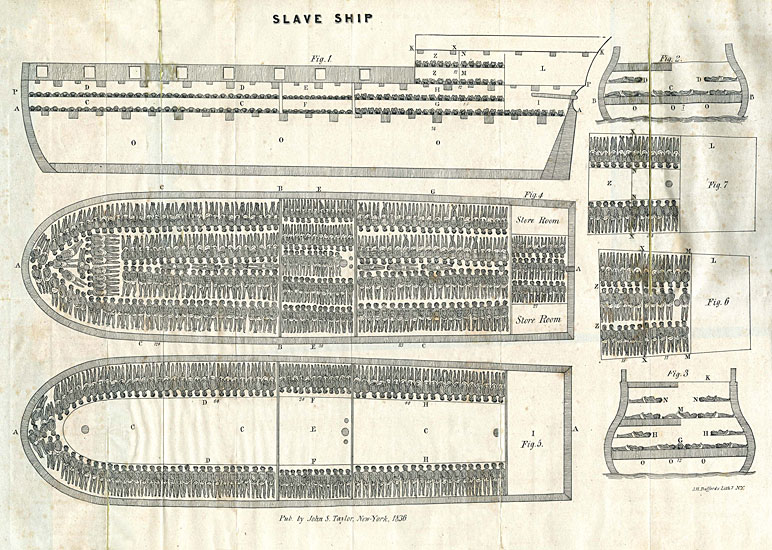
Slave ship Brooks: In: T. Clarkson's The History of the Rise, Progress, and Accomplishment of Abolition of African Slave-Trade by the British Parliament, v. 2 (New York, 1836).
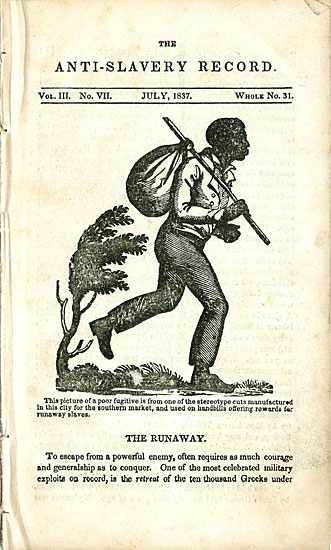
"The Runaway," The Anti-Slavery Standard, III/7 (1837 July), p. 1.
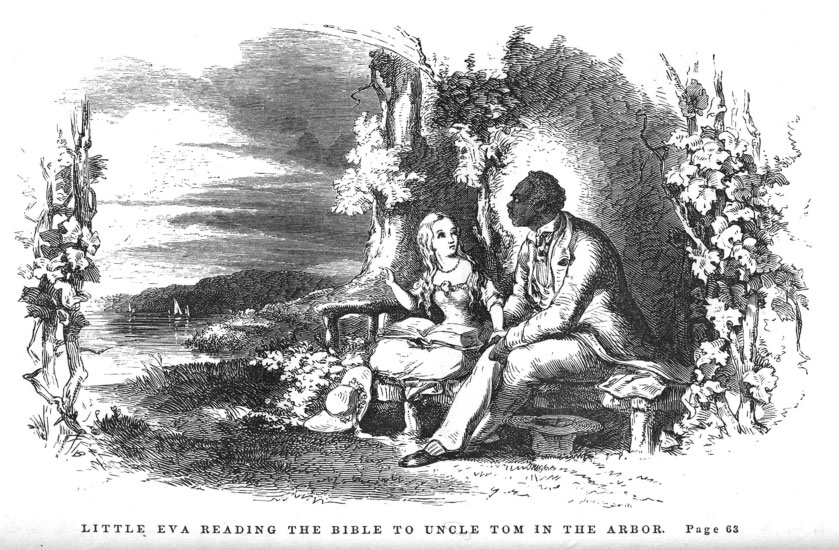
"Little Eva Reading the Bible to Uncle Tom in the Arbor." Illustration by Hammat Billings, in Harriet Beecher Stowe's Uncle Tom's Cabin (Boston, 1852).
Please note when the library recently updated our online catalogs, the links in our subject guides broke. We are working actively to fix this problem. In the meantime, you can search for materials referenced by consulting the library catalog and our catalog of archives and manuscript materials.
Because of the social, cultural, political, and intellectual engagement of Bowdoin College's students, alumni, and faculty, especially in their connections to antislavery movements and the Civil War, and because of the general reading interests of Bowdoin students about slavery and emancipation, the Bowdoin College Library has accumulated and acquired a substantial collection of manuscript resources and printed works that document both antislavery movements and the sentiments of slavery apologists.
In England and America, pro- and antislavery sentiments were articulated mainly through newspapers and pamphleteering. These publications shaped the debate at the time, and they survive today both as artifacts from the period and as resources for current scholars in understanding why and how advocates adopted their respective positions. Pamphlets by notable abolitionists Angelina Grimke, Horace Mann, William Lloyd Garrison, and Gerrit Smith are all represented among these resources, as are the published constitutions, bylaws, as are published proceedings of numerous colonization and abolitionist societies, both white and black.
More substantial works on slavery and abolition are also in the collection, including:
- Lydia Maria Child's An Appeal in Favor of that Class of Americans Called Africans (Boston, 1833), the first exhaustive, systematic analysis of modern slavery, in which she called for immediate emancipation and full social integration, including interracial education and marriage.
- Thomas Clarkson's The History of the Rise, Progress, and Accomplishment of Abolition of African Slave-Trade by the British Parliament (3 vols.; New York, 1836), also known as the Cabinet of Freedom, which details the abolitionist movement in England and includes iconic illustrations, including a map that charts English abolitionism and a diagram of the slave ship Brook that characterized the essential brutality of the slave trade.
- Slave narratives (including those about Frederick Douglass, Pierre Touissant, and Henry Box Brown), which appeared from the 1830s onward and proved powerful both in shaping antislavery sentiment and in influencing white writers like Harriet Beecher Stowe to advance the cause of emancipation.
- Phillis Wheatley's “On the Capture of General Lee,” a poem written in her hand in 1776 and inscribed for James Bowdoin, the future governor of Massachusetts in whose memory Bowdoin College was named.
- Numerous editions and adaptations of Harriet Beecher Stowe's Uncle Tom's Cabin, first published in serialized installments in The National Era, an influential newspaper published in Washington, D.C., by the American and Foreign Anti-Slavery Society before appearing in book form in 1852. Stowe's influential antislavery novel was written here in Brunswick, much of it penned in the Appleton Hall campus office of her husband, Calvin Ellis Stowe, then Collins Professor of Natural and Revealed Religion.
- The Fessenden Collection, a substantial manuscript collection documenting the lives and sentiments of this politically influential antislavery family, which included William Pitt Fessenden (U.S. senator from Maine and Lincoln's Treasury secretary).
- The Charles Vaughan Papers, containing manuscripts and publications that document planter life from this Hallowell, Maine, family who had plantation interests in eighteenth-century Jamaica.
- Bills of sale for slaves, and other miscellaneous documents referring to slave movements, escapes, and recaptures (see: Miscellaneous Manuscripts; Edward Page Mitchell Collection [1778]; Shepley Papers [1776]; Tucker Shipping Papers [“Samoset” 1848]; E.A. Pierce Collection).
Newspapers in the collection, especially from the late eighteenth and early nineteenth centuries, carry notices about slavery and the slave trade; many were published specifically to further antislavery agendas: William Lloyd Garrison's Liberator and Non-Resistant; Lydia Maria Child's National Anti-Slavery Standard; The National Era; and the Advocate of Freedom, the paper of the Maine Anti-Slavery Society edited for a time by Bowdoin mathematics professor William Smyth. Smyth's role in rendering aid to fugitive slaves passing through Brunswick is recounted in his son George's “Reminiscences of My Life.” Antislavery Materials at Bowdoin College: A Finding Aid, edited by Angela M. Leonard and published by the College in 1992, provides a general outline for further research possibilities.
Catalog information can be general, however, and so more detailed descriptions, especially for manuscripts, are also available online, as is a comprehensive guide for Africana Studies that summarizes the indexes, databases, edited versions of primary sources, and reference books available through the library's collections and services.
The summary provided here highlights those primary resources at Bowdoin that are especially rich in documenting the enslavement of Africans, their passage to the Americas, and the subsequent African American experience, particularly in Jamaica and the United States.